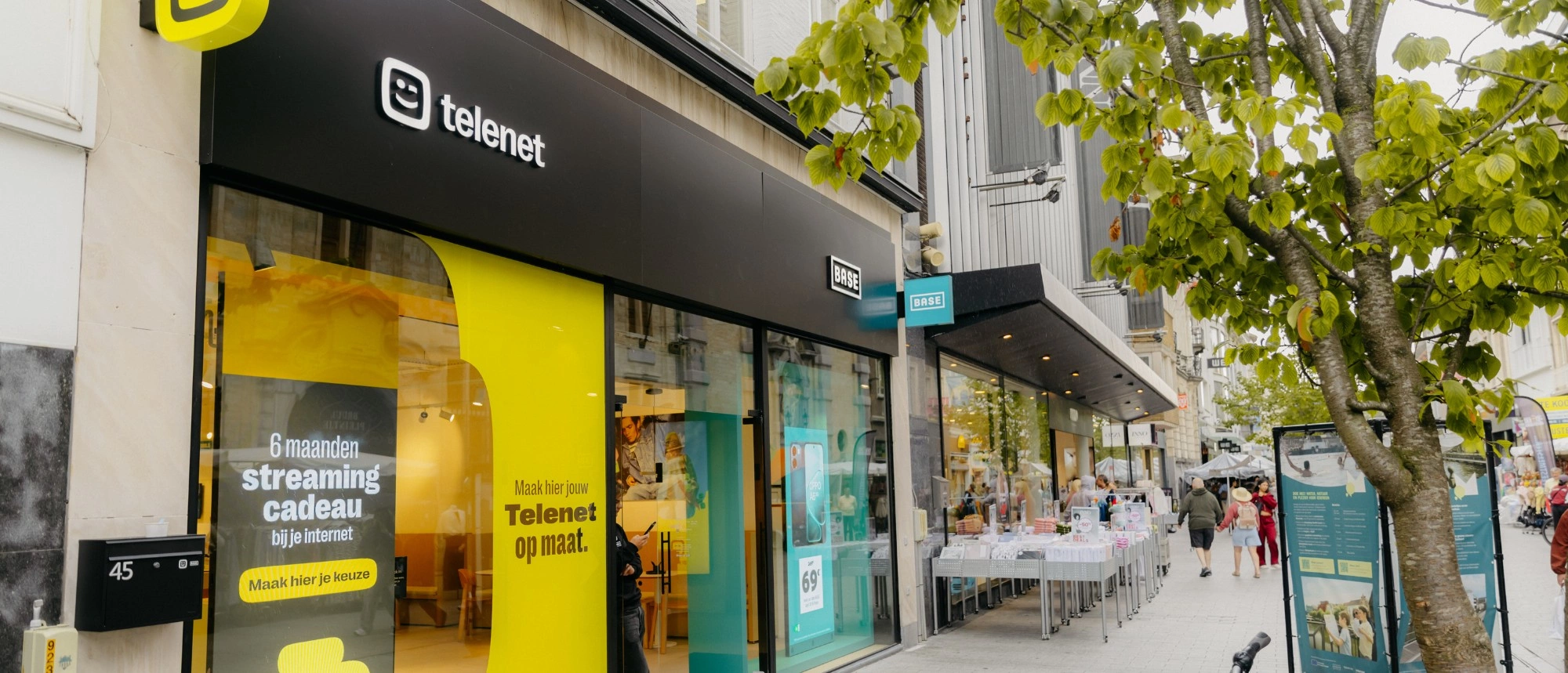
When Gerry Weber went bankrupt, Bruul 45 in Mechelen became vacant. For the previous owner, that created uncertainty. For a new investor, it created an opportunity.
Avenue advised on the sale of the vacant property to a private investor. But the transaction wasn’t the end of the story. It was the beginning of a repositioning strategy that would bring together acquisition, leasing, renovation and energy optimisation.
Today, the result of that strategy is becoming visible. Telenet/Base is preparing to open a new dual brand store at the property, combining two existing stores into one location on one of the strongest sections of Bruul. The interesting part isn’t simply that a vacant store found a new tenant. It’s what had to happen in between.
- Vacancy changed the investment case
For investors, vacancy is often perceived primarily as risk. There is no rental income, the future tenant is unknown and capital expenditure may be required before the property can compete again. But vacancy also creates flexibility.
Instead of acquiring somebody else’s investment strategy, the buyer of Bruul 45 had the opportunity to create a new one. That distinction matters.
The question wasn’t simply whether the property could be leased again. It was whether its location and underlying fundamentals justified investing in its next chapter.
- The location provided the conviction
Bruul remains Mechelen’s dominant high street. More importantly, Bruul 45 sits on one of its strongest sections. That gave the investor something vacancy couldn’t take away: a fundamentally strong location.
The arrival of Telenet/Base validates that reasoning. The retailer will use the property to combine two stores into one dual brand concept, bringing both brands together at a single prime location.
The building therefore wasn’t repositioned around just any available tenant. It was matched with an occupier for whom this particular location supported a broader retail strategy.
- Reletting was only part of the value creation
Securing a strong tenant solved one part of the investment equation. The building itself also needed to evolve.
Following the acquisition, the property underwent a substantial renovation. The façade was brought back in line with the streetscape, the roof was renewed and new windows were installed.
Avenue also advised the owner with a specific focus on improving the property’s EPC performance. That matters because value creation in today’s high street market increasingly happens at the intersection of commercial and technical decisions.
A good lease strengthens cashflow. A better building protects its relevance. Combine both and the investment case changes fundamentally.
- The deal started after the deal
That’s perhaps the most interesting lesson from Bruul 45. A transaction isn’t always where value is realised. Sometimes it’s where value creation starts.
The investor didn’t acquire a perfectly leased, fully renovated turnkey investment. The investor acquired a vacant building in a strong location and subsequently improved the different components of the asset.
New tenant.
New retail concept.
Improved energy performance.
Improved energy performance.
The result is a fundamentally different asset from the one that changed hands. For owners and investors facing vacancy, that’s an important distinction.
Vacancy doesn’t automatically destroy the investment case. In the right location, with the right strategy and the right capital expenditure, it can create the window to reposition an asset for its next cycle.
Is vacancy changing the investment case for one of your properties?
Sometimes the right decision is to sell. Sometimes it’s to reinvest, reposition and relet. Avenue advises owners and investors on both sides of that decision.
Have a comparable situation? Talk to us via elena@avenue.eu.